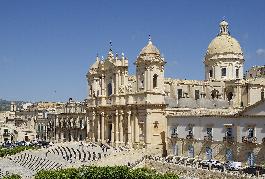
Noto is a baroque city in southeastern Sicily that feels deliberately composed rather than simply built—an urban landscape shaped by reconstruction, symmetry, and a shared architectural vision. After the devastating earthquake of 1693, the city was rebuilt in its current location, resulting in a remarkably coherent historic center where golden limestone façades create a unified visual tone under strong Mediterranean light.
The main axis of the city unfolds along a gentle slope, guiding movement through a sequence of churches, palazzi, and stair-stepped piazzas. The most defining architectural moment is the Noto Cathedral, which rises at the top of a broad staircase and anchors the skyline with restrained baroque geometry. Its pale stone surface changes character throughout the day, shifting from warm gold to soft amber as the sun moves.
Nearby, aristocratic residences such as the Palazzo Nicolaci di Villadorata introduce a more intricate layer of detail—balconies supported by carved figures, ornate ironwork, and façades that turn everyday streets into theatrical sequences. Walking through these streets feels like moving through an architectural continuum where repetition and variation are carefully balanced.
Despite its formal elegance, Noto is not static. Small bakeries, cafés, and local shops occupy ground floors of historic buildings, keeping the city grounded in daily life. The rhythm of the streets is slow and deliberate, especially in the late afternoon when light sharpens edges and the stone seems almost luminous.
Beyond the urban core, the landscape quickly shifts into dry hills, citrus groves, and coastal plains. A short distance away lies the protected coastline of the Vendicari Nature Reserve, where salt marshes, dunes, and quiet beaches form a stark contrast to the refined geometry of the city. Here, ruins of old tuna fisheries sit in open landscapes shaped by wind and migratory birds rather than architecture.
What defines Noto is its sense of unity: a city where architecture, material, and light operate as a single system. It is both monumental and intimate, a place where every street feels like part of a larger composition, and where baroque expression is not decoration but the organizing logic of the entire urban form. |
| Add Review [Reviews Guidelines] |
| Only registered Holiday members may write reviews. Register. |



 Greek
Greek  English