Marsala occupies a broad, low-lying stretch of western Sicily where land, salt, and sea blur into a flat horizon. Unlike hill towns that announce themselves dramatically, Marsala unfolds slowly—wide streets, sun-bleached stone, and an agricultural hinterland that extends toward salt pans and shallow lagoons. The atmosphere is open and wind-shaped, with light that feels especially sharp at the edge of the island.
The historic center carries a layered identity shaped by Phoenician, Roman, Arab, and Spanish influences. Elegant baroque façades sit alongside older, more restrained structures, and the rhythm of daily life moves between shaded piazzas and long, bright avenues. Wine culture is deeply embedded here—Marsala is the birthplace of its namesake fortified wine, and cellars beneath the town still anchor much of its identity.
Just north of the town lies the striking lagoon system of the Stagnone Lagoon, one of the most unusual coastal landscapes in Italy. It is extremely shallow, almost mirror-like, and broken by salt pans, windmills, and narrow strips of land. The water shifts from silver to pale turquoise depending on light and wind, creating a constantly changing surface that feels more atmospheric than maritime.
Within this lagoon sits the small island of Mozia, an archaeological site of major Phoenician heritage. Reached by a short boat crossing, it offers quiet paths through ruins, stone walls, and coastal remains where history is layered directly onto salt-bleached terrain. The experience is minimal and exposed, with sea and sky dominating everything between the fragments of ancient settlement.
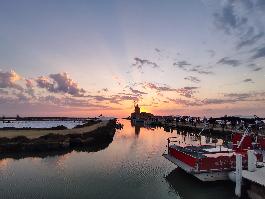
Along the edges of the lagoon, traditional salt pans still operate, forming geometric pools that intensify color as evaporation progresses. Windmills and shallow basins create a rhythmic landscape that feels both industrial and natural, especially at sunset when the entire area turns gold and pink.
What defines Marsala is its horizontal character and elemental clarity: salt air, open plains, and a coastline that does not rise to meet you but spreads outward indefinitely. It is a place where land is measured in light and wind rather than elevation, and where history, agriculture, and sea coexist in a wide, unbroken field of view. |
| Add Review [Reviews Guidelines] |
| Only registered Holiday members may write reviews. Register. |



 Greek
Greek  English