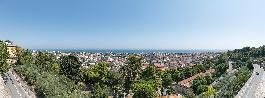
Giulianova lies on the Adriatic coast of Abruzzo, structured in two distinct parts that reflect different layers of its history and geography. The town is divided between an elevated historic center inland and a more modern coastal district that stretches along the sea.
The upper town, known as Giulianova Alta, sits on a hill overlooking the coastline. It is organized with a degree of symmetry unusual for medieval settlements, featuring wider streets and a more ordered layout. At its heart stands the Cathedral of San Flaviano, a notable circular church whose dome rises above the surrounding buildings and anchors the skyline. From this higher position, views extend across the Adriatic and the flat coastal plain below.
Descending toward the sea, the landscape opens into Giulianova Lido, the newer part of the town. Here, the environment becomes linear and expansive, with long sandy beaches, a marina, and a promenade lined with palm trees. The shoreline is wide and gradual, with shallow water typical of the Adriatic, creating a calm and accessible coastal setting.
The harbor area introduces a working maritime element, with fishing boats and leisure vessels sharing space, reinforcing the town’s connection to the sea beyond tourism. The transition between the elevated historic center and the coastal strip defines the overall experience of Giulianova, linking past and present through changes in altitude and function.
Inland, the terrain shifts into gentle hills with agriculture—olive groves and vineyards—forming a softer backdrop that contrasts with the openness of the coast.
What defines Giulianova is its dual structure: a composed, elevated town looking outward from above, and a modern, horizontal extension along the shoreline. The interaction between height and flatness, history and contemporary life, creates a balanced but clearly divided identity. |
| Add Review [Reviews Guidelines] |
| Only registered Holiday members may write reviews. Register. |



 Greek
Greek  English