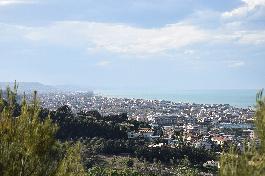
Pescara is the largest urban center on the Adriatic coast of Abruzzo, a modern, horizontally expanded city where river, sea, and flat coastal plain converge into a single continuous urban fabric. Unlike older Italian cities defined by historic cores, Pescara is characterized by openness, mobility, and a strong relationship with its shoreline.
The city is divided by the Pescara River, which flows into the Adriatic and creates a natural axis through the urban structure. On either side, long boulevards, residential blocks, and commercial districts extend toward the sea, reinforcing a sense of breadth rather than enclosure.
At the waterfront, the long sandy beaches form one of Pescara’s defining features. The shoreline is wide, accessible, and gently sloping, with shallow water extending far from the coast. A continuous promenade runs parallel to the sea, lined with palms, cycling paths, and leisure spaces that structure daily life around movement and exposure to light.
The city center is more contemporary than historic, shaped by 20th-century development and post-war reconstruction. It lacks a dense medieval core, instead presenting a grid-like organization with broad streets and functional zoning. This gives Pescara a distinctly modern Mediterranean character—practical, open, and oriented toward circulation.
Culturally, the city has strong literary and artistic associations, most notably with Gabriele D’Annunzio, whose birthplace is preserved as the Casa Natale di Gabriele D’Annunzio. This adds a historical and symbolic dimension that contrasts with the city’s otherwise contemporary structure.
Beyond the urban area, the landscape quickly transitions into the hills of Abruzzo, where vineyards, olive groves, and small towns rise from the coastal plain. This proximity between sea and mountains creates a compressed geography that is one of the region’s defining traits.
What defines Pescara is its clarity and horizontal scale: a city without strong vertical hierarchy or historic containment, where life is organized along axes of river, road, and shoreline. It feels dynamic and outward-facing, shaped more by movement and modern expansion than by enclosed historic form. |
| Add Review [Reviews Guidelines] |
| Only registered Holiday members may write reviews. Register. |



 Greek
Greek  English