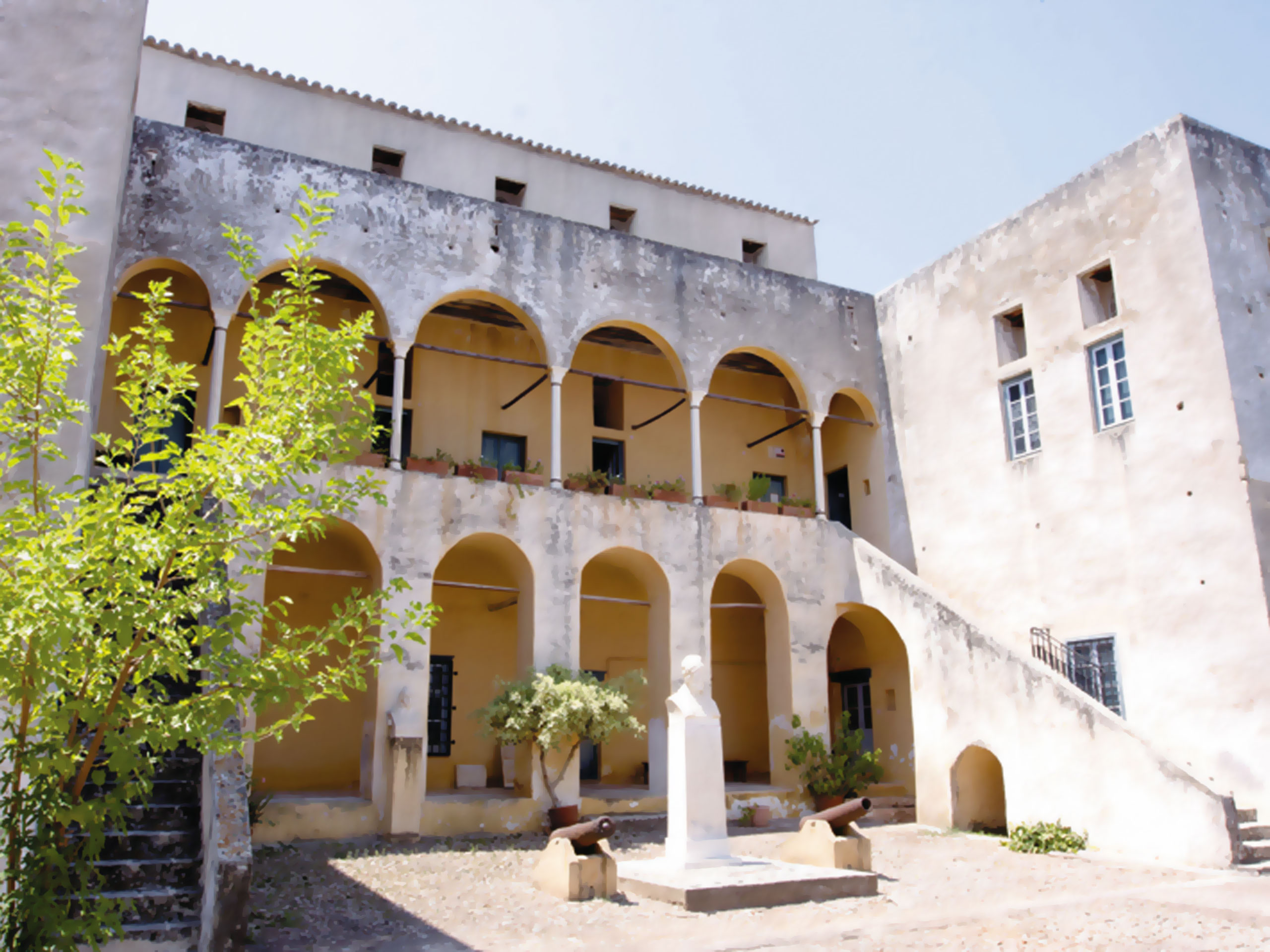
The Mansion of Chatzigiannis-Mexis, who was one of the first leading figures of Spetses during the years of the Greek War of Independence, was donated to the State in 1938 by his heirs, Kalomoira Mexi and Niketa Thermisioti-Katsina. In 1939, it began operating as the Museum of Spetses, functioning as the island's Archaeological, Historical, and Folklore Collection.
This imposing building, with its high arches, was built between 1795 and 1798 in a U-shaped layout. It was declared a preserved monument in 1924 and houses objects representing more than 4,000 years of the island's cultural history, covering all forms of artistic expression.
The Museum of Spetses consists of a ground floor and two upper floors. On the ground floor, where the private quarters of Chatzigiannis Mexis were located (his office, dining room, and the room with the safe), are now exhibited finds from the pre-Mycenaean shipwreck of Iria, dating to around 1200 BC.
On the first floor, there are two spacious rooms that served as women's quarters and guest rooms, while on the second floor there was the typical unified space of a Spetses house, the "grand hall" (megαlos ontαs), featuring an exceptional carved wooden ceiling.
On these two floors, the exhibits of the Spetses Museum are displayed, including:
Pottery and vessels from the Early Helladic and Classical periods.
Funerary steles, sculptures, and coins from the Roman and Byzantine periods.
A collection of post-Byzantine and Russian icons, along with other ecclesiastical objects.
Ceramics of Eastern and European art, brought back from the travels of Spetses sailors in the late 18th century.
Traditional Spetses costumes, everyday objects, examples of woodcarving (chests, furniture), and embroidery.
Important relics from the Greek War of Independence of 1821, including the revolutionary flag, the ossuary of Bouboulina, weapons belonging to her and other fighters, historical documents, personal items, portraits of Spetses naval commanders, watercolors and oil paintings of ships from the War, and rare wooden ship figureheads.
Opening hours: 08:30 - 14:00 daily except Monday
Contact phone: +30 22980 72994
Website: odysseus.culture.gr
The Bouboulina Museum
The 300-year-old mansion of Laskarina Bouboulina, with its unique carved ceiling in the grand hall, has been operating as a museum since 1992. It offers a guided tour of approximately 40 minutes, during which visitors learn about the life and work of Bouboulina while viewing relics from the War of Independence, her personal belongings, and other notable exhibits.
The Bouboulina Mansion consists of a ground floor and two upper floors. The museum is housed on the first floor, which includes four large rooms: the Grand Hall, the Reception Room, the Dining Room, and the Fireplace Room. Access to the museum is via an external stone staircase located in the courtyard.
In the Grand Hall, with its beautiful Florentine-style carved wooden ceiling and Italian-French furnishings of the 18th and 19th centuries, there is a collection of weapons from the 1821 period, including Bouboulina's pistol. Also displayed are the safe of the ship "Agamemnon," with its three keys and eight locks, portraits of the heroine and her descendants, and the well-known oil painting depicting her attacking the fortresses of Nafplio.
In the Reception Room stands a large painting, a copy of the famous work by Peter von Hess, showing Bouboulina ordering the bombardment of Nafplio. Also on display are portraits, engravings, her personal belongings, letters from the Revolution-including two signed by her-an African sword gifted by Tsar Alexander I, rare books in the library, and her gold-embroidered headscarf. The room also includes a medallion of hers, commemorative medals, fine porcelain, and a collection of ancient oil lamps. Mounted on the wall is the Ottoman permit (firman of the Sultan) for the construction of the ship "Agamemnon," with its design on the reverse side.
In the Dining Room stands a handmade wooden model of the ship "Agamemnon," along with collections of porcelain-mainly of English and Chinese origin-post-Byzantine icons (notably that of Saint Nicholas, which belonged to Bouboulina), and rare books displayed in cases.
In the Fireplace Room, furnished mainly with 19th-century pieces, there are photographs of her descendants and various everyday objects. Notable items include a Venetian bridal chest, a French gilded clock with Sθvres porcelain, French miniatures, embroidery, decorative textiles, maps, commemorative items, and period oil paintings. This room is separated from the Reception Room by a built-in wooden cupboard known as a "mesandra," which also functioned as a hiding place.
The museum remains closed during the winter months. It opens for the Clean Monday holiday weekend and then operates daily from March 25 to October 28.
Opening hours: 08:30 - 14:00 daily except Monday
Contact phone: +30 22980 72416
Fax: +30 22980 72077
Website: bouboulinamuseum-spetses.gr
Email: bouboulina@aig.forthnet.gr



 Greek
Greek  English



 THE MUSEUM OF SPETSES