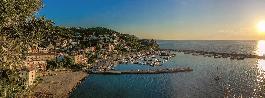
Agropoli sits along the Cilento coast in southern Campania, where a rocky promontory rises above the Tyrrhenian Sea and forms the foundation of its historic core. The town is divided between this elevated, older settlement and the more expansive, modern areas that stretch along the shoreline below.
The upper town is accessed through a steep, curving stone ramp that leads to the Agropoli Castle, a fortress positioned at the highest point of the headland. From here, the view opens across the coastline and inland hills, giving a clear sense of the town’s strategic placement between sea and land. The historic center surrounding it is compact, with narrow streets, small squares, and buildings arranged tightly along the contours of the rock.
Below, the town extends outward into a broader coastal strip where daily life is more dispersed. The harbor and waterfront form a focal area, with fishing boats and leisure vessels sharing space, maintaining a connection to Agropoli’s maritime roots.
The coastline alternates between sandy beaches and rocky stretches. Among the most notable is Trentova Bay, a wide, open beach set against low hills and natural surroundings, offering a softer contrast to the more enclosed, elevated historic center.
Inland, the landscape transitions quickly into the hills of the Cilento National Park, where forests, agricultural land, and scattered villages create a quieter, more rural backdrop. This proximity to protected natural areas reinforces the sense that Agropoli sits at a boundary between developed coastline and less altered terrain.
What defines Agropoli is its dual structure: a defensive, elevated core rooted in history, and a more open, linear coastal extension shaped by modern life. It feels both contained and outward-facing, where the relationship between height and shoreline continues to organize how the town is experienced. |
| Add Review [Reviews Guidelines] |
| Only registered Holiday members may write reviews. Register. |



 Greek
Greek  English