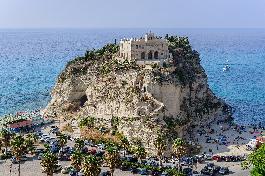
Tropea stands dramatically along Calabria’s Tyrrhenian coast, perched atop sheer sandstone cliffs that drop directly into intensely clear, turquoise water. The town appears almost suspended above the sea, its pale buildings aligned along the edge as if held in place by the rock beneath them.
Below the cliffs lies a narrow strip of beach, where the contrast between golden sand and vivid blue water is particularly striking. Rising from this shoreline, on a separate rocky outcrop, is the iconic Santa Maria dell’Isola, a monastery-like structure surrounded by vegetation and accessed by a steep staircase. It forms the visual centerpiece of Tropea, bridging land and sea in a way that feels both natural and constructed.
The historic center above is compact and layered, with narrow streets, small squares, and buildings that often open abruptly onto panoramic viewpoints. From these edges, the coastline stretches in both directions, and on clear days the distant silhouette of the Aeolian Islands appears faintly on the horizon.
Tropea’s position creates a strong vertical relationship between town and sea. Movement is defined by descent—paths, stairways, and roads leading from the elevated center down toward the beach. This constant shift between heights and water shapes the experience of the place.
Beyond the town, the coastline alternates between cliffs and accessible beaches, while inland areas transition into a quieter agricultural landscape known for its red onions, a local specialty tied closely to the region’s identity.
What defines Tropea is its sense of elevation and exposure: a town that lives above the sea rather than beside it. The combination of dramatic cliffs, clear water, and tightly arranged historic spaces creates an environment where every view feels immediate and every edge feels significant. |
| Add Review [Reviews Guidelines] |
| Only registered Holiday members may write reviews. Register. |



 Greek
Greek  English