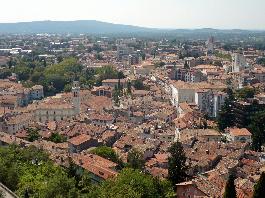
Gorizia sits at Italy’s northeastern edge, pressed directly against the border with Slovenia, where the line between countries feels more historical than physical. The town shares an urban fabric with its neighbor across the border, creating a layered identity shaped by Italian, Slavic, and Austro-Hungarian influences.
The historic core gathers beneath the hilltop Gorizia Castle, a medieval fortress that overlooks both the Italian town and the Slovenian city of Nova Gorica. From its elevated position, the view reveals a landscape of gentle hills, tiled roofs, and a subtle blending of cultures rather than a sharp division.
At ground level, Gorizia’s streets reflect its Central European character. Broad avenues, elegant squares, and restrained façades distinguish it from the denser, more vertical towns of southern Italy. The Piazza della Vittoria serves as a focal point, framed by churches and civic buildings that carry a quiet, formal symmetry.
The town’s history is marked by shifting borders and conflict, particularly during the First World War, when this region was a major frontline. That legacy remains present in nearby sites and in the cultural memory of the area, adding a layer of depth beneath its otherwise calm surface.
Surrounding Gorizia, the landscape transitions into vineyards and low hills that are part of the broader Friuli wine region. This agricultural setting softens the town’s edges, connecting it to a wider terrain known for white wines and a slower rural rhythm.
What defines Gorizia is its in-between quality: not fully Italian in atmosphere, yet not separate from it. It is a place where influences overlap rather than compete, where architecture, language, and daily life carry traces of multiple histories, and where the concept of a border becomes something experienced subtly rather than seen directly. |
| Add Review [Reviews Guidelines] |
| Only registered Holiday members may write reviews. Register. |



 Greek
Greek  English