Otranto Otranto
 |
Otranto lies on Italy’s easternmost edge, where the Adriatic Sea narrows toward the Balkans and the sense of geographic boundary becomes tangible. The town faces outward across open water, and on clear days the distant coastline of Albania feels almost within reach, reinforcing its long history as a point of contact—and conflict—between cultures.
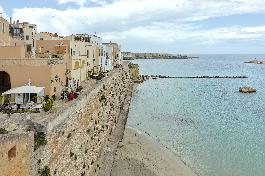
The historic center is compact and fortified, enclosed by thick walls that speak to centuries of strategic importance. Entering through its gates, the space tightens into a network of narrow, whitewashed streets that open intermittently onto small squares and terraces overlooking the sea. At its core stands the Otranto Cathedral, known for its vast mosaic floor—an intricate, symbolic composition that stretches across the interior and anchors the town’s cultural identity.
Along the waterfront, the Aragonese Castle of Otranto guards the harbor, its heavy stone mass projecting strength against the brightness of the surrounding sea. The port itself is modest, with fishing boats and small vessels reinforcing a quieter maritime rhythm compared to larger coastal hubs.
Beyond the walls, the coastline becomes more expansive and elemental. To the south, the landscape transitions into the protected area of Alimini Lakes and a series of beaches backed by dunes and pine forests. The water here is clear and often intensely blue, shifting with depth and light, while the terrain alternates between sandy stretches and low rocky outcrops.
Otranto’s atmosphere is shaped by light and exposure. The buildings reflect the sun sharply, and the sea is always present—visible at the end of streets, beyond walls, or below terraces. Even within the town, there is a persistent sense of being at the edge of something larger.
What defines Otranto is its threshold quality: a place where Italy feels both complete and unfinished, facing outward toward another horizon. It is not just a coastal town, but a boundary point—geographical, historical, and cultural—where land, sea, and distant continents converge.
|
|



 Greek
Greek  English





 Map
Map