DUBAI DUBAI
 |
|
|
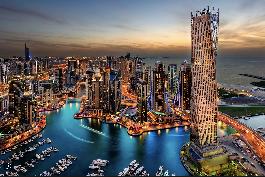
Dubai rises from the edge of the Arabian Desert along the Persian Gulf, a city defined by rapid transformation, vertical ambition, and engineered landscapes. It is not shaped by gradual historical layering in the traditional sense, but by deliberate construction—an environment where scale, geometry, and visibility are central to its identity.
The coastline has been extensively reconfigured, most notably with projects like Palm Jumeirah, an artificial archipelago extending into the sea in a precise, symbolic form. Along the shore, long beaches and waterfront developments create a continuous interface between land and water, designed for access, leisure, and visual impact.
Inland, the city rises sharply into clusters of high-rise towers, with the skyline dominated by structures such as the Burj Khalifa, which defines both the physical and symbolic center of modern Dubai. Surrounding it, wide highways, large-scale developments, and carefully zoned districts create a sense of spatial order at a metropolitan scale.
Despite its modernity, Dubai retains traces of its earlier identity along the Dubai Creek, where older districts reflect its origins as a trading port. Here, the scale is smaller, and the relationship to water is more traditional, with boats, markets, and narrower streets offering contrast to the expansive developments elsewhere.
Beyond the urban area, the desert begins abruptly. Sand dunes extend outward in all directions, creating a stark boundary that reinforces the city’s constructed nature. The desert is not distant—it is immediately adjacent, shaping climate, light, and the sense of isolation from other regions.
What defines Dubai is its intentionality: a city built through vision and engineering rather than gradual evolution. It is a place of contrasts—desert and water, low horizons and extreme verticality, traditional fragments and futuristic forms—where the environment is continuously reshaped to project scale, possibility, and control. |
|



 Greek
Greek  English