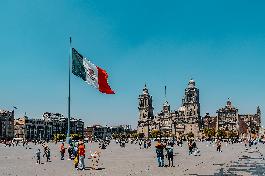
Mexico spans a vast and varied landscape in North America, where deserts, mountains, jungles, and coastlines coexist within a single national framework. Its geography is expansive and often extreme, creating sharp contrasts in climate, elevation, and vegetation across regions.
In the central highlands, around Mexico City, the terrain rises into a broad plateau surrounded by volcanic peaks. The altitude shapes both climate and urban form, producing cooler temperatures and a dense, layered metropolis built upon centuries of indigenous and colonial foundations. Nearby, volcanoes such as Popocatépetl dominate the horizon, reinforcing the sense of geological activity that underlies much of the country.
To the north, the landscape becomes increasingly arid, transitioning into desert and semi-desert regions with sparse vegetation and wide, open space. In contrast, the south and southeast, including areas like Yucatán Peninsula, are low-lying and tropical, characterized by dense vegetation, limestone terrain, and underground water systems such as cenotes.
Mexico’s coastlines further diversify its identity. Along the Pacific, beaches are often backed by cliffs and strong surf, while the Caribbean side, near Cancún, features white sand and clear, shallow turquoise water. These coastal differences reflect broader environmental contrasts across the country.
Culturally, Mexico is deeply rooted in a fusion of indigenous civilizations and Spanish colonial influence. Ancient sites such as Chichén Itzá remain central to its historical identity, while colonial cities, markets, and everyday traditions continue to reflect this blending. Color, texture, and material play a strong role in the built environment, from painted façades to handcrafted details.
The country’s atmosphere is also defined by rhythm and intensity—busy urban centers, active street life, and strong regional identities that vary in language, cuisine, and tradition. Despite modernization, there is a persistent connection to land, history, and local practice.
What defines Mexico is its multiplicity: a nation of extremes and intersections, where environments shift dramatically and cultural layers remain visible. It is not a single landscape or identity, but a composite of regions that together form a complex and continuously evolving whole. |
| Add Review [Reviews Guidelines] |
| Only registered Holiday members may write reviews. Register. |



 Greek
Greek  English